
Tangram
Seven flat pieces, cut from one square, can become a cat, a boat or a house. Nothing is added and nothing is left over. The whole trick is in how each piece is turned and where it goes.
Free sets by level, ages 4–10:
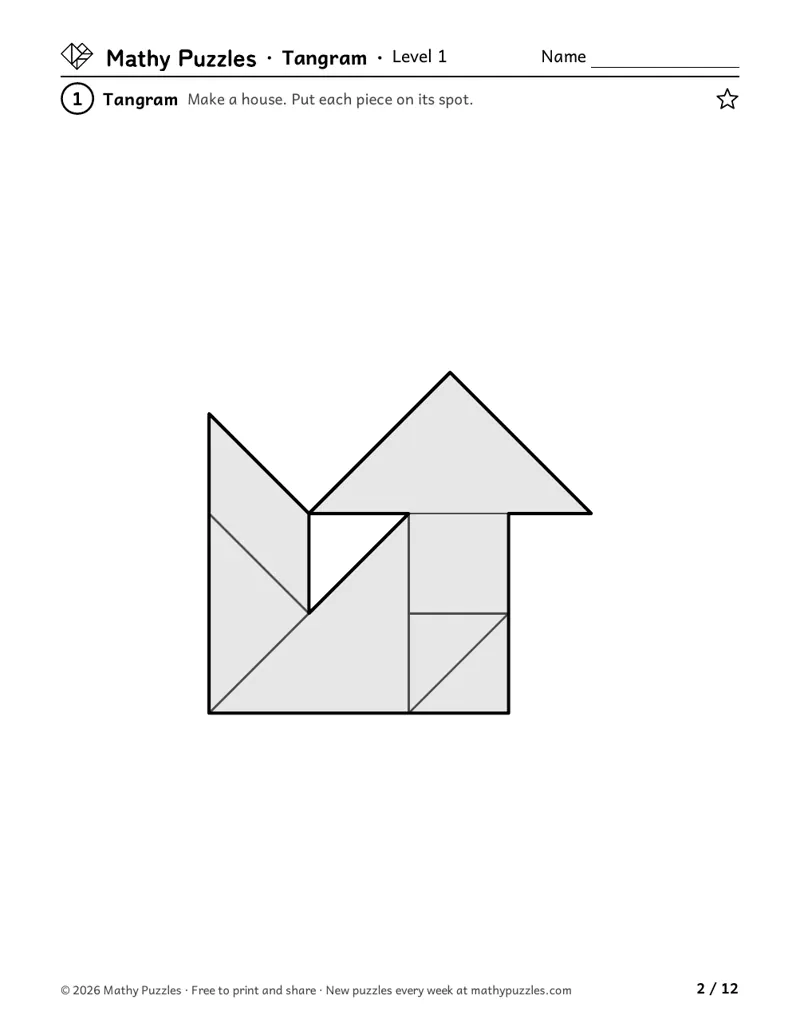 Level 1: a page from the free set
Before starting
- Turn and place small pieces, or draw a straight line on the outline
- Name a triangle and a square
- Turn a piece in their hand to try it another way
What you need
Our tangram pieces sheet, printed on card stock; scissors to cut out the 7 pieces; and a pencil.
Free printable: Tangram pieces
Free puzzles to print
Each set: a Learn sheet with a worked example, 10 puzzles from easiest to hardest, and the answers.
Printing: Print at 100% ("Actual size"). Turn off any "Fit" or "Shrink" option, so the pieces match the puzzles.
Level 1
Ages 4–6 · Pre-K–K
The easiest puzzles: a picture outline with every line between the pieces drawn in; put each piece on its spot.
The middle puzzles: one line between two pieces is missing, so the child works out which two pieces share that space.
The hardest puzzles: two lines are missing.
On the sheet: “Fill the shape with all 7 pieces. They can't overlap.”
Print Level 1 (Letter)Other paper size: A4Level 2
Ages 6–8 · Grades 1–2
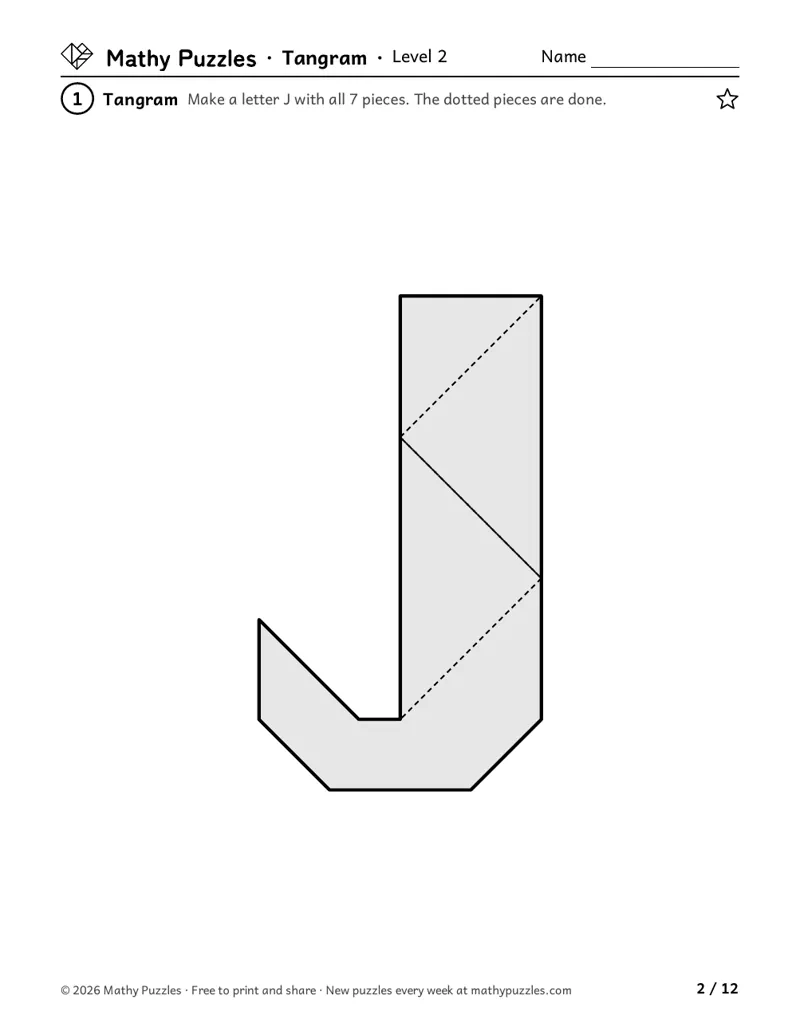
The easiest puzzles: the two big triangles are drawn in dotted lines to start you off.
The middle puzzles: one big triangle is drawn for you.
The hardest puzzles: outline only, with no help.
On the sheet: “Fill the shape with all 7 pieces. They can't overlap.”
Print Level 2 (Letter)Other paper size: A4Level 3
Ages 8–10 · Grades 3–4
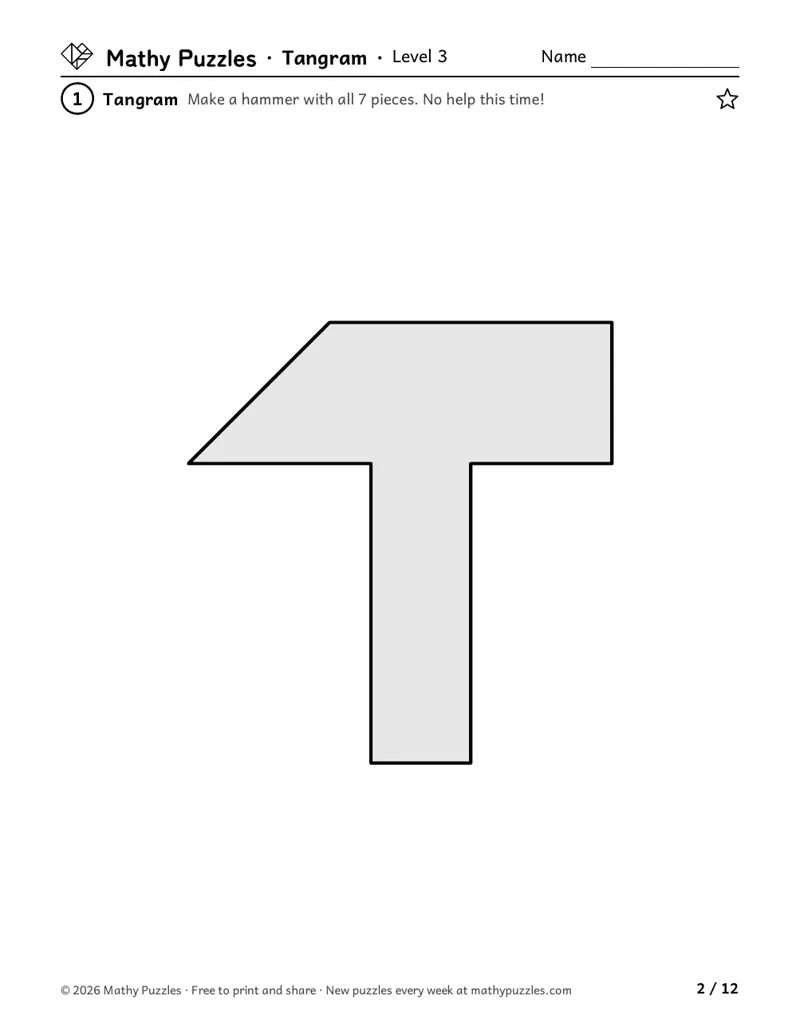
Outline only, every time. The easiest figures stick out in places, which hints where pieces go; the hardest are compact, close to a plain block, so the outline gives few clues.
On the sheet: “Fill the shape with all 7 pieces. They can't overlap.”
Print Level 3 (Letter)Other paper size: A4
How it works
A tangram starts as a square cut into 7 pieces: two big triangles, a middle triangle, two small triangles, a square and a slanted shape called a parallelogram. Each sheet shows the outline of a figure, such as an animal or a boat. The child lays all 7 pieces from our tangram set inside it, or draws where they go. At Level 1 the lines between the pieces are drawn in. Level 2 gives less help. At Level 3 there is only the outline, and the child has to find the pieces inside it.
How to play
- Print our tangram pieces sheet and the puzzles at actual size (100%), and cut out the 7 pieces. They are the same size as the shapes on every puzzle sheet. Store-bought sets are often a different size, so their pieces may not sit on the shapes.
- Look at the outline. Find the places where only a big triangle could fit.
- Place the big pieces first, then the middle ones, then the small ones.
- Use all 7 pieces with no gaps and no overlaps. Any way that works is right.
When it gets hard
Leaving the parallelogram for last and finding it won't fit.
Hint: The parallelogram may need flipping over. Try the other side up.
Starting with the small pieces.
Hint: Big pieces have the fewest places they can go. Start with them.
Giving up when a filling differs from the answers.
Hint: The answers show one way. If all 7 pieces fit with no gaps and no overlaps, it is right.
Tip for grown-ups: Do the cutting for younger children. Keep the pieces in an envelope so they can be reused for every tangram sheet; pieces cut from card stock last all year.
Frequently asked questions
- My child filled the outline a different way. Is it wrong?
- No. If all 7 pieces are used with no gaps and no overlaps, it works. A shape may be made more than one way; the answers show one example.
- Do I need a tangram set for every student?
- One set per student or pair is ideal. Print our tangram set on card stock, cut it out, and keep each set in an envelope all year. Other sets are often a different size and won't match the outlines. Without sets, students draw where the pieces go on the outline.
Questions about printing, levels, answers or membership: see all questions.
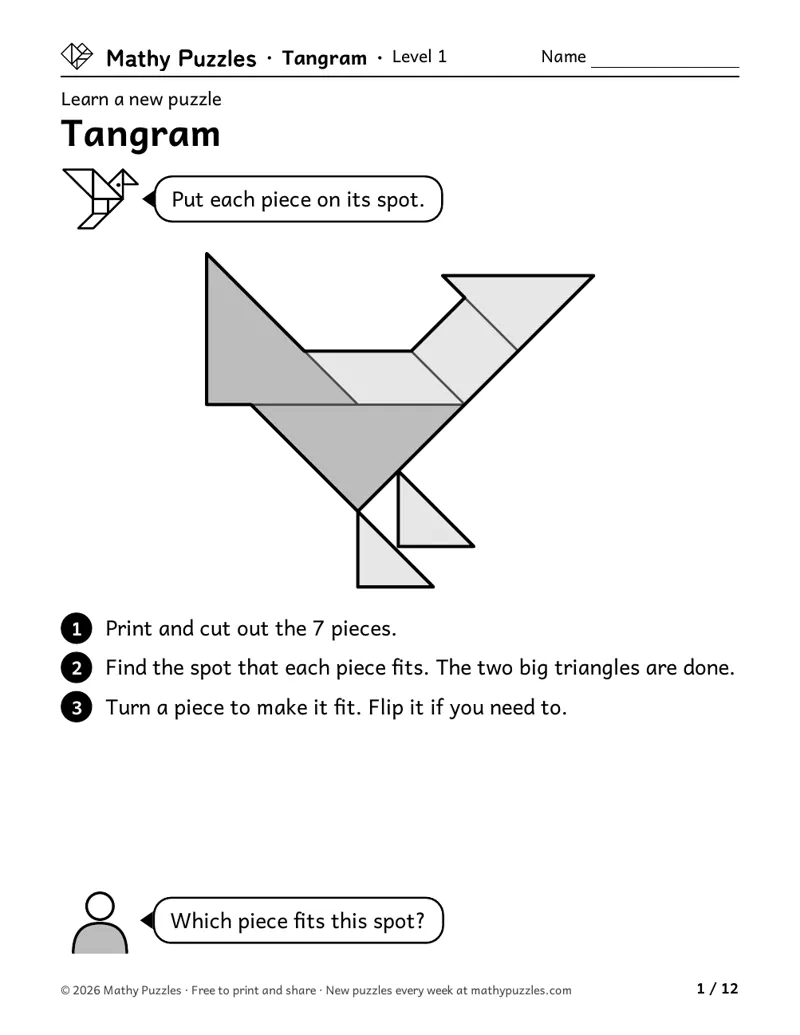
Worked example
From the Level 1 Learn sheet
- Print and cut out the 7 pieces.
- Find the spot that each piece fits. The two big triangles are done.
- Turn a piece to make it fit. Flip it if you need to.
A question to ask: “Which piece fits this spot?”
Free every Sunday A mixed bag of 20 new puzzles, all four levels. Get them by email
The thinking it works on
Building a figure from pieces
Fills an outline with all seven pieces, big triangles first, with no gaps or overlaps.
Clements, Wilson and Sarama (2004) followed 72 children aged 3 to 7. They moved from trial and error, to choosing pieces by their sides and corners, to combining pieces into new shapes they can reuse. Source
Turning and flipping pieces
Turns a piece, and flips the parallelogram, to make it fit.
Frick, Hansen and Newcombe (2013) asked children to pick the shape that fits a hole only when turned, against its mirror image. Success rose from 10% of 3-year-olds to 95% of 5-year-olds. Source
Seeing a whole as parts
Spots the corners where only a big triangle can go, then fills what's left.
Verdine and colleagues (2014) found that 3-year-olds' skill at copying a block build from a model on the table already went along with their early math skills. Source
Trying, checking and changing a plan
Moves pieces around when a gap won't fill, instead of forcing them.
Diamond (2013) describes switching to a new approach when the first one fails (cognitive flexibility) as a core thinking skill that grows through childhood. Source
Same pieces, same amount of space
Notices every figure uses the same seven pieces, so all cover the same space.
Lautrey, Mullet and Paques (1989) found that children who did not yet see that an area stays the same judged a rectangle's size by one side. Those who did used both sides. Source
Where is this thinking used?
- Tiling and patchwork: Set shapes cover a floor or a quilt with no gaps.
- Cutting cloth, wood and metal: Pattern pieces are laid out so the least is wasted.
- Packing: Turning a piece is often what makes it fit in a suitcase or box.
- Logo and icon design: A few simple shapes make a picture.
For teachers
Curriculum areas
- Common Core
- Geometry: compose simple shapes into larger shapes (K–1); Geometry: partition shapes (Grades 1–3)
- NCERT
- Shapes chapters (Classes 1–3), including the tangram activity in Fun with Shapes (Class 3)Level 1: No direct curricular match.
- National Curriculum (England)
- Early years mathematics: spatial reasoning with shape and space (Reception)Levels 2–3: No direct curricular match.
- Cambridge Primary Mathematics
- Geometry and measure: making a shape by combining shapes (Stage 4)Level 1: No direct curricular match.
Math practices: see the box below.
Math practices this puzzle uses
- Uses: MP1 Make sense of problems and persevere in solving them
- Not used: MP2 Reason abstractly and quantitatively
- Not used: MP3 Construct viable arguments and critique the reasoning of others
- Not used: MP4 Model with mathematics
- Not used: MP5 Use appropriate tools strategically
- Not used: MP6 Attend to precision
- Uses: MP7 Look for and make use of structure
- Not used: MP8 Look for and express regularity in repeated reasoning
From the Common Core Standards for Mathematical Practice.
More Tangram puzzles for members
Members get at least 5 more worksheets at each difficulty for every puzzle, 80 new puzzles every Sunday, and the whole archive. $39 a year or $25 for 6 months.
See membershipNot ready yet?
One email, all four levels: 20 puzzles, 5 for each level.
For grown-ups (18+). One email every Sunday with the puzzles and the odd note about membership; unsubscribe any time. We never ask about your child. How we use your email