
Odd One Out
A banana, a lemon, a sun and an apple: which one doesn't belong? The apple, if you are thinking of color; the sun, if you are thinking of food. Odd One Out is about naming the way that matters here, and saying why.
Free sets by level, ages 4–8:
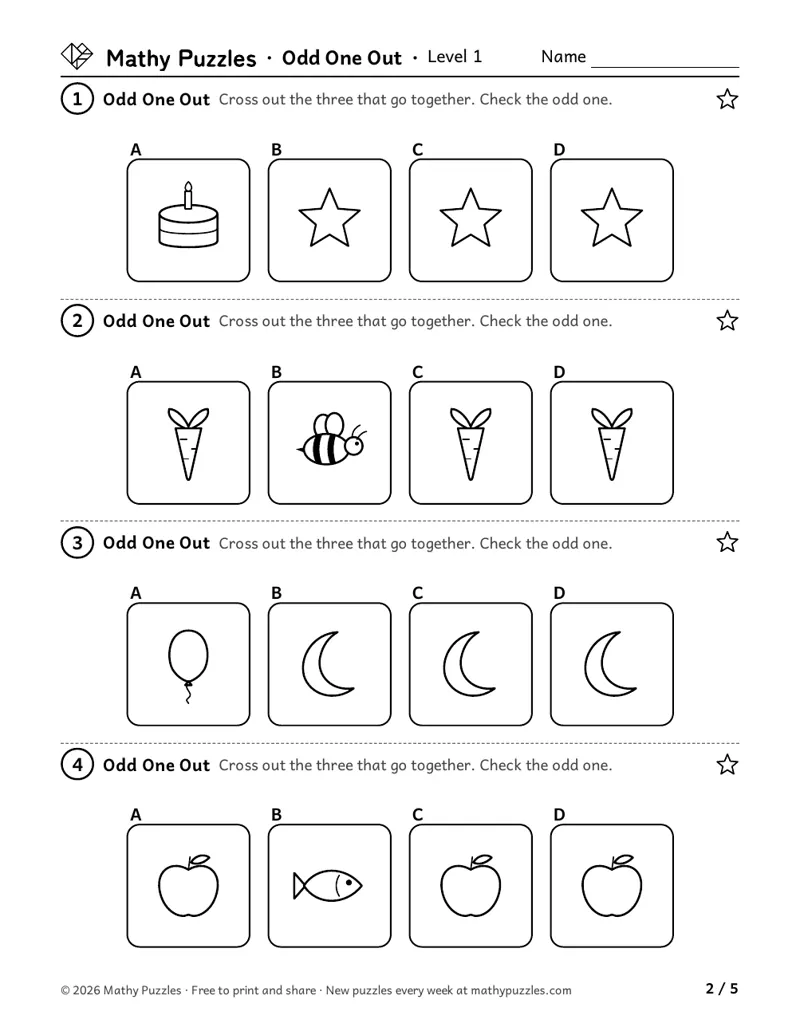 Level 1: a page from the free set
Before starting
- Name common shapes and objects
- Count to 4 (Level 1) or 6 (Level 2)
- Hold a crayon to cross out
Free puzzles to print
Each set: a Learn sheet with a worked example, 10 puzzles from easiest to hardest, and the answers.
Level 1
Ages 4–6 · Pre-K–K
A different object, then the same object with one in a different size or facing another way, then one box with a different count.
On the sheet: “Cross out the three that go together. Check the odd one.”
Print Level 1 (Letter)Other paper size: A4Level 2
Ages 6–8 · Grades 1–2
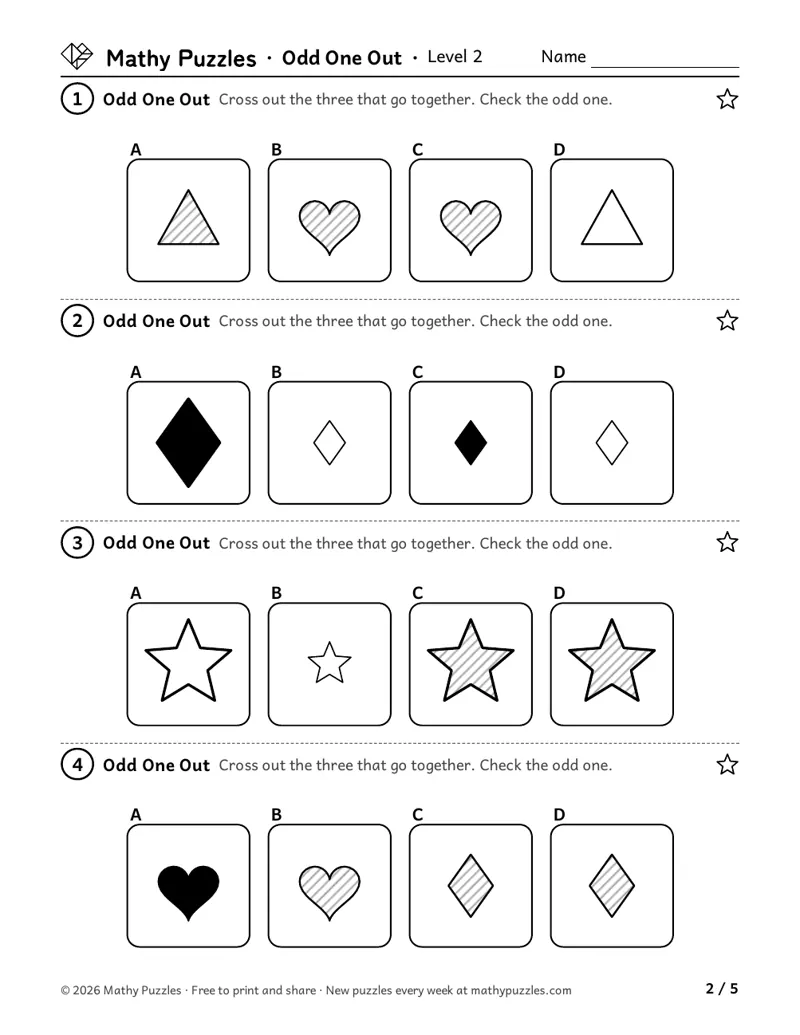
Shapes where one box differs in shape, fill or size. A decoy feature splits the boxes two and two; then there are two decoys. The hardest have one box with a different number of small shapes (1 to 6).
On the sheet: “Cross out the three that go together. Check the odd one.”
Print Level 2 (Letter)Other paper size: A4
How it works
Each puzzle has four boxes of pictures. Three of them share something; one is different. The child crosses out the three that go together and checks the one that doesn't belong, then says why.
How to play
- Look at all four boxes before choosing.
- Ask: what is the same about three of them? Shape? Size? How it is filled in? Which way it faces? How many?
- Cross out the three that go together.
- Check the odd one, and say what makes it different.
When it gets hard
Picking the first difference noticed, which splits the boxes two and two.
Hint: Your odd one should be the only one that is different. Are there two that share that difference?
Choosing without a reason.
Hint: Finish this sentence before checking: "It is the odd one because..."
Missing a count difference.
Hint: Count the things in every box, even if they look the same.
Tip for grown-ups: Play it with real objects first: three spoons and a fork, or three red blocks and a blue one. Then try the sheet.
Frequently asked questions
- My child picked a different box with a good reason.
- Talk about it; naming a reason is the skill. Then look together for the box that is different in a single way, which is what the puzzle asks.
Questions about printing, levels, answers or membership: see all questions.
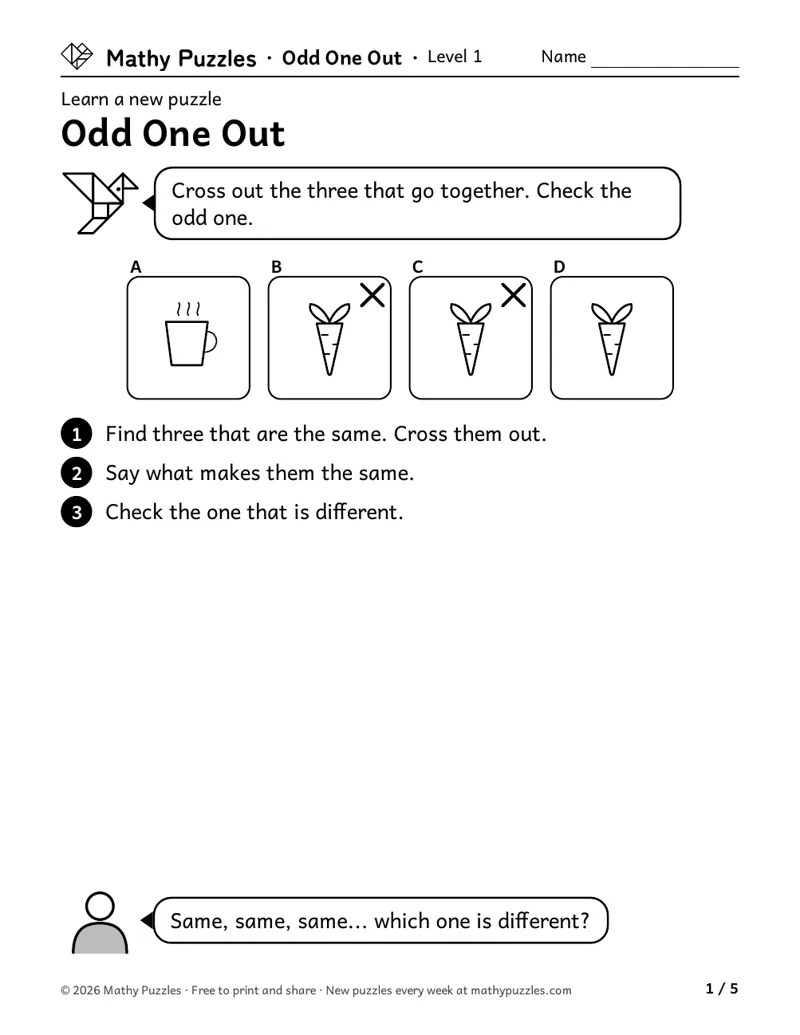
Worked example
From the Level 1 Learn sheet
- Find three that are the same. Cross them out.
- Say what makes them the same.
- Check the one that is different.
A question to ask: “Same, same, same... which one is different?”
Free every Sunday A mixed bag of 20 new puzzles, all four levels. Get them by email
The thinking it works on
Comparing feature by feature
Asks what three of the four boxes share: object, size, direction, fill or count.
Gentner and Namy (1999) found that young children who compared two examples side by side tended to match by kind, while those shown one example matched by looks. Source
Switching the feature you sort by
Drops a feature that splits the boxes two and two and tries another.
Zelazo (2006) reports that on a card-sorting task, most 3-year-olds keep sorting by the first rule, such as color, after being told to switch to shape. By 5, most switch. Source
Ignoring differences that don't matter
Sets aside a difference that two boxes share.
Seeing small counts at a glance
Sees at a glance that one box holds a different number of things.
Schleifer and Landerl (2011) timed children saying how many dots they saw. With age, the time changed less for small groups, seen at a glance, than for larger groups that had to be counted. Source
Explaining a choice
Says why the odd one is different before checking it.
Where is this thinking used?
- Sorting: Laundry, groceries, a toolbox or a collection.
- Checking lists: Spotting the one entry that doesn't match in a list or a table.
- Science: Grouping living things or materials by a feature.
- Quality checks: One item in a batch is different from the rest.
For teachers
Curriculum areas
- Common Core
- Measurement and data: classifying objects into categories and counting how many are in each (Kindergarten)
- Common Core
- Counting and cardinality: comparing small groups (Kindergarten)
- NCERT
- Joyful Mathematics (Classes 1–2): sorting objects into groups, and crossing out the odd one
- National Curriculum (England)
- Early years number: comparing quantities (Reception); Geometry: comparing and sorting shapes (Year 2)
- Cambridge Primary Mathematics
- Number: counting objects (Stage 1); Geometry and measure: sorting 2D shapes (Stage 2)
Math practices: see the box below.
Math practices this puzzle uses
- Not used: MP1 Make sense of problems and persevere in solving them
- Not used: MP2 Reason abstractly and quantitatively
- Uses: MP3 Construct viable arguments and critique the reasoning of others
- Not used: MP4 Model with mathematics
- Not used: MP5 Use appropriate tools strategically
- Not used: MP6 Attend to precision
- Uses: MP7 Look for and make use of structure
- Not used: MP8 Look for and express regularity in repeated reasoning
From the Common Core Standards for Mathematical Practice.
More Odd One Out puzzles for members
Members get at least 5 more worksheets at each difficulty for every puzzle, 80 new puzzles every Sunday, and the whole archive. $39 a year or $25 for 6 months.
See membershipNot ready yet?
One email, all four levels: 20 puzzles, 5 for each level.
For grown-ups (18+). One email every Sunday with the puzzles and the odd note about membership; unsubscribe any time. We never ask about your child. How we use your email