
Number Paths
Numbers in order are like a road: each step is one more. Here the road has to wind through the whole grid, every number touching the next, so the space decides where it can turn.
Free sets by level, ages 4–12:
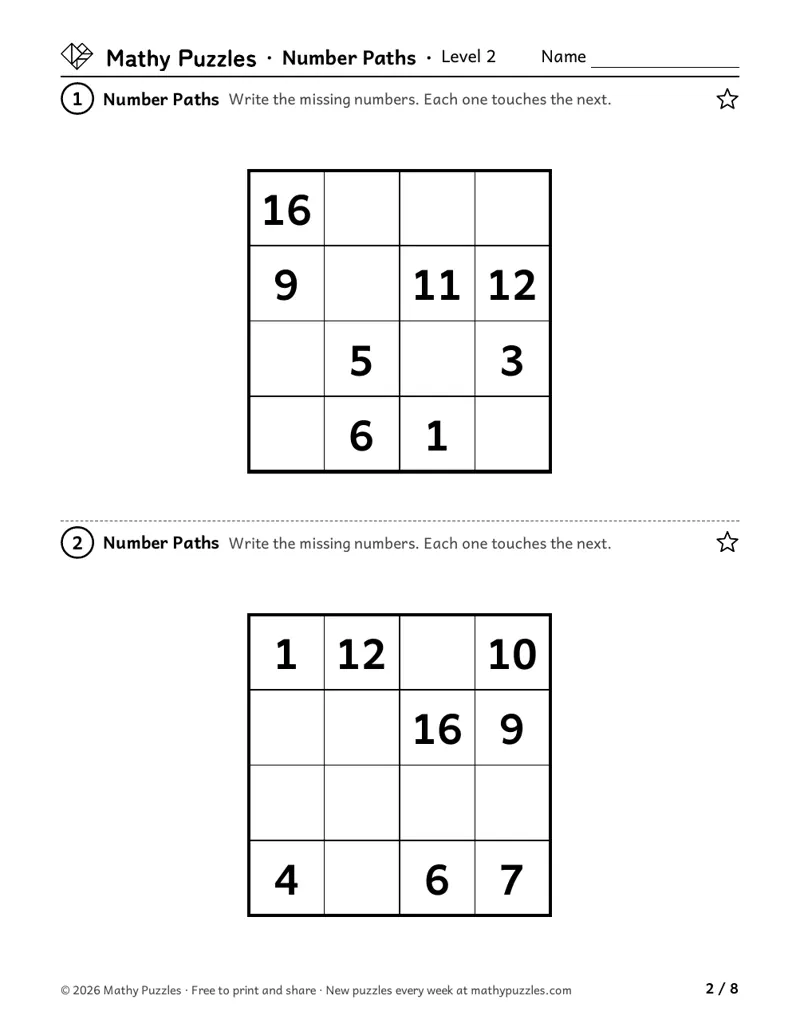 Level 2: a page from the free set
Before starting
- Level 1: count to 9 or 16 and write numbers to 16
- Level 2: count to 25, and count by 2s to 50, by 5s to 125 and by 10s to 160
- Level 3: count to 37, count by 3s and 4s to 144, and by 25s to 625
- Level 4: count to 49
Free puzzles to print
Each set: a Learn sheet with a worked example, 10 puzzles from easiest to hardest, and the answers.
Level 1
Ages 4–6 · Pre-K–K
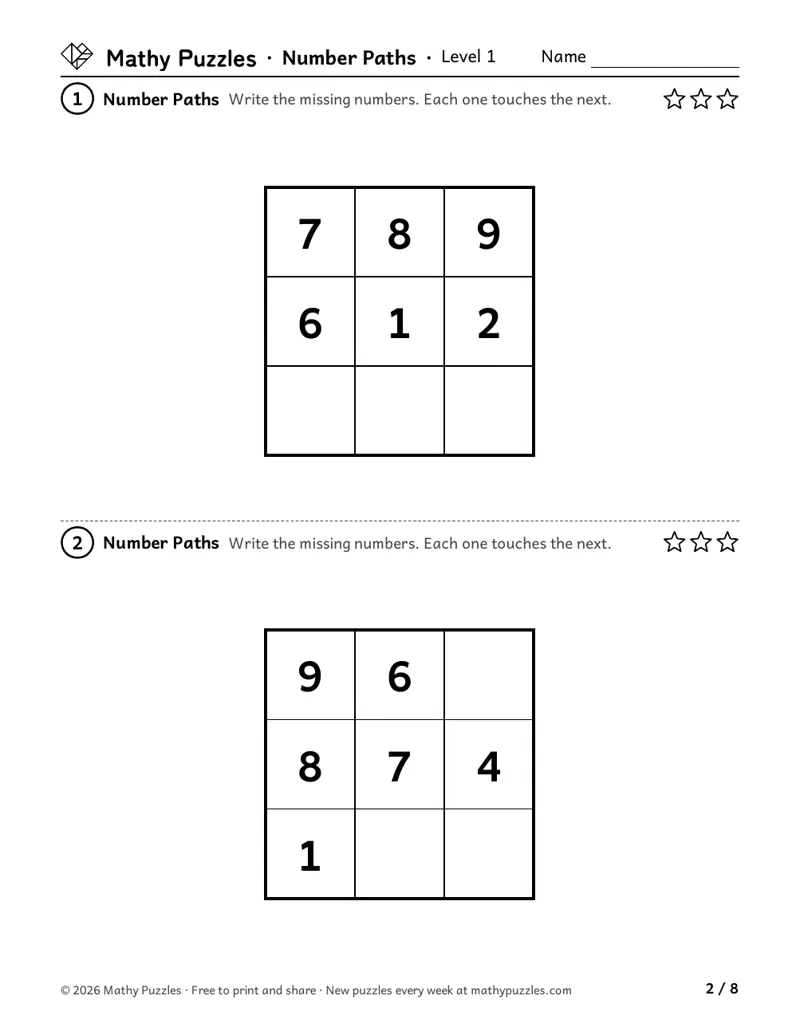
Joins late, in the harder puzzles with a 3 × 3 grid (1–9) or a 7-cell honeycomb (1–7), then a 4 × 4 (1–16).
On the sheet: “Write the missing numbers. Each one touches the next.”
Print Level 1 (Letter)Other paper size: A4Level 2
Ages 6–8 · Grades 1–2
Mixes Number Paths and skip counting. Number Paths: 4 × 4 with 6 to 8 numbers given, then 5 × 5 with fewer numbers given, and a 19-cell honeycomb at the hardest end. Skip counting: by 10s on a 4 × 4, then by 5s and by 2s on a 5 × 5; the hardest are 19-cell honeycombs counting by 2s or 5s.
On the sheet: “Write the missing numbers. Each number touches the next one.”
On the sheet: “Write the missing numbers. Each one touches the next.”
On the sheet: “Count on by the same number. Each number touches the next.”
Print Level 2 (Letter)Other paper size: A4Level 3
Ages 8–10 · Grades 3–4
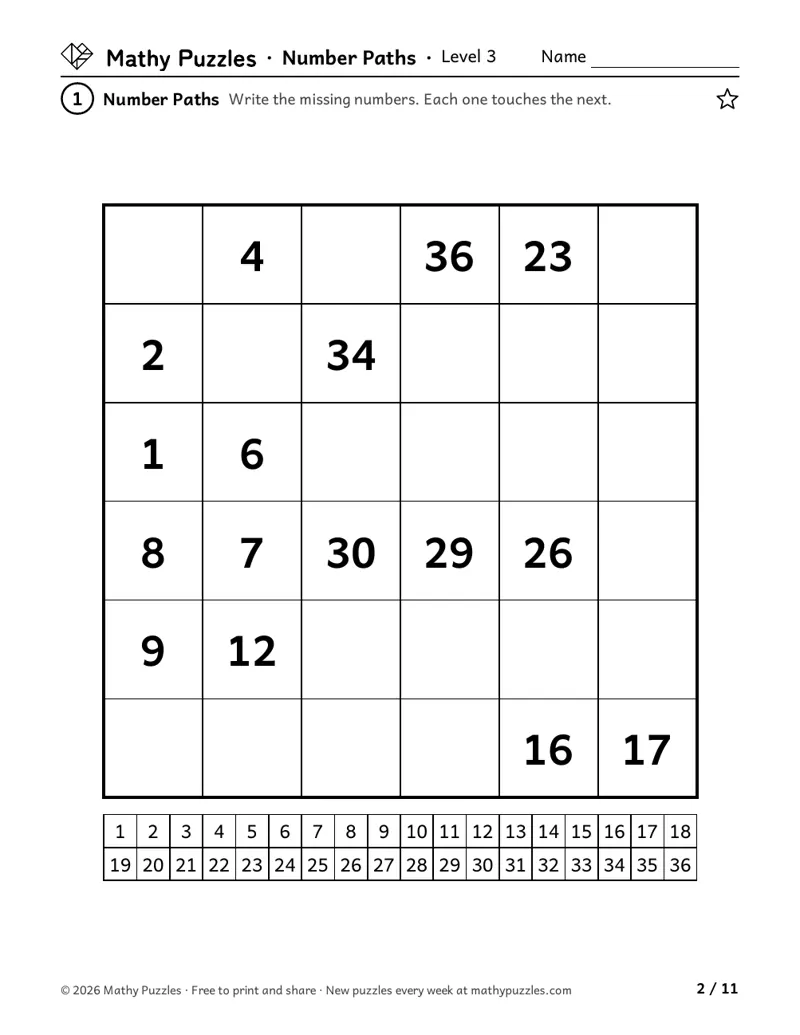
Mixes two kinds. Number Paths: 6 × 6 grids, first with easy moves, then needing step counting, then big honeycombs of 25 and 37 cells. Skip counting: by 3s on a 5 × 5, then by 4s or 25s, then by 3s or 4s on a 6 × 6 (up to 144). The hardest skip-count puzzles are honeycombs of 25 and 37 cells. In the hardest puzzles of both kinds, neither the first nor the last number is shown.
On the sheet: “Write the missing numbers. Each one touches the next.”
On the sheet: “Count on by the same number. Each number touches the next.”
Print Level 3 (Letter)Other paper size: A4Level 4
Ages 10–12 · Grades 5–6
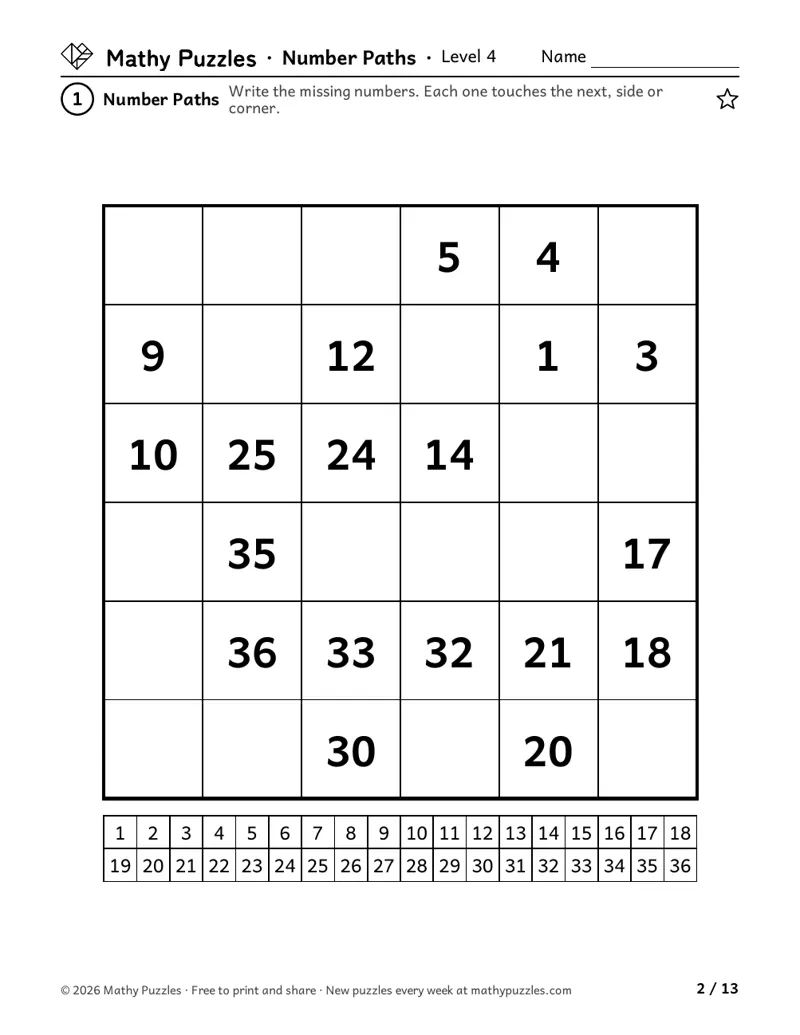
Corners touch too, so each square has up to eight neighbors. First a 6 × 6 (1 to 36), then 7 × 7 grids (1 to 49) with fewer numbers given. Then puzzles that need step counting; in the hardest, neither 1 nor 49 is shown.
On the sheet: “Write the missing numbers. Each one touches the next, side or corner.”
Print Level 4 (Letter)Other paper size: A4
How it works
Each puzzle is a grid with some numbers written in. The child fills the empty squares so the numbers run in order, each one touching the next, like a snake winding through the whole grid. Most puzzles count 1, 2, 3 and on. Skip-count puzzles at Levels 2 and 3 go up by the same number each time (10, 20, 30… or 4, 8, 12…). Touching means sharing a side, except at Level 4, where corners touch too. The first and last numbers are usually shown so the child knows where to start and finish.
How to play
- Find the first number. Look at the squares touching it. Where can the next number go? In a skip-count puzzle, say the count first: 5, 10, 15…
- Look for gaps: if 4 and 6 are written, 5 goes in the square that touches both.
- If a number has only one empty neighbor, the next number goes there.
- Keep going until every square has a number. Check that each number touches the next (at Level 4, a corner counts as touching).
When it gets hard
Joining numbers corner to corner at Levels 1 to 3.
Hint: At Levels 1 to 3, each number must share a side with the next one. Only Level 4 lets corners touch.
Leaving a square that the path can't reach.
Hint: Look for a corner square with only one empty neighbor. It must be an end of a stretch.
Running out of room before reaching the next given number.
Hint: Count: from 7 to 12 you need exactly 5 steps. Is your route that long?
In a skip-count puzzle, writing the next counting number (13 after 12) instead of the next number of the count.
Hint: Read the count at the top first. Counting by 4s, 16 comes after 12.
Tip for grown-ups: Let your child write numbers lightly in pencil; Number Paths often need one or two numbers erased and moved.
Frequently asked questions
- Is a honeycomb a different puzzle?
- No, the same rule on six-sided cells, so each number can touch up to six others. Small honeycombs appear at Level 1, 19-cell ones at Level 2, and 25- and 37-cell ones at Level 3. Level 4 goes back to squares but lets corners touch, so each square has up to eight neighbors.
- How do we know a filled grid is right?
- Check that every square has a number and that each number touches the next. If both hold, the grid is right; the answers show an example. Erasing and moving a number or two along the way is normal, not a mistake.
Questions about printing, levels, answers or membership: see all questions.
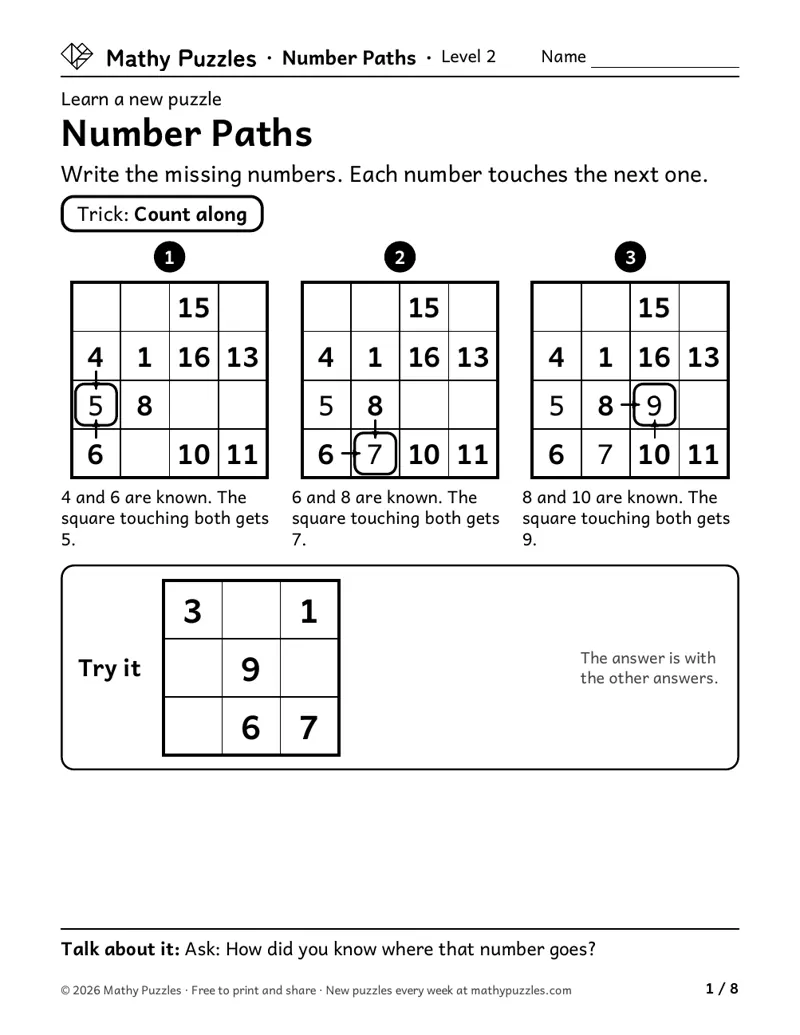
Worked example
From the Level 2 Learn sheet
- Write the missing numbers. Each number touches the next one.
- Two numbers with one gap between them, like 3 and 5? The square touching both gets the 4.
- A number with only one empty neighbor? The number before or after it goes there.
- Keep going until every square is filled.
A question to ask: “How did you know where that number goes?”
Free every Sunday A mixed bag of 20 new puzzles, all four levels. Get them by email
The thinking it works on
Counting forward and backward from any number
Counts on from any written number, and back from it too.
Secada, Fuson and Hall (1983) found that first graders who counted on could count up from any starting point, among other skills. Most who still counted from one lacked at least one of these skills. Source
Placing only what must go there
Places a number only when the squares around it force it.
In Pillow and Pearson's (2009) study, third graders rated a conclusion that had to follow from what they saw as surer even than a well-supported hunch. Source
Counting steps between two numbers
Counts how many steps two numbers need and looks for a route that long.
Planning a path that fills the space
Looks ahead so no square is left that the path can never reach.
Unterrainer and colleagues (2013) followed children from ages 4 and 5 for a year on a planning puzzle. Most solved easy ones, and look-ahead problems got easier with age. Source
Knowing which squares touch
Keeps 'touching' to the rule: four neighbors on a grid, six on a honeycomb, eight at Level 4.
Keeping track and backing out
Writes lightly, backs out when a stretch runs out of room, and finds the hidden ends.
Conklin and colleagues (2007) found that tasks needing children to hold and rearrange information in mind kept getting easier through the teen years. Source
Where is this thinking used?
- Routes: Errands or deliveries that visit every stop once.
- Counting on: Finding a seat or a house from a number you can see.
- Cables and paths: Laying a pipe or a garden path that must not cross itself.
- Planning jobs: Every space is used exactly once.
For teachers
Curriculum areas
- Common Core
- Counting and cardinality: counting forward from a given number; writing numerals (Kindergarten)
- Common Core
- Number and operations in base ten: counting to 120 starting from any number (Grade 1), skip counting by 5s and 10s (Grade 2); Operations and algebraic thinking: patterns in the multiplication table (Grade 3)Level 4: No direct curricular match.
- NCERT
- Joyful Mathematics: a path through 1 to 9 and writing numbers in order (Class 1), a 1–100 board with missing numbers (Class 1), the number chart and skip counting (Class 2); Maths Mela: jumps of the same size (Class 4)Level 4: No direct curricular match.
- National Curriculum (England)
- Number – number and place value: counting and writing numbers in order (Year 1); counting in steps (Years 2–4)Level 4: No direct curricular match.
- Cambridge Primary Mathematics
- Number: counting and ordering numbers (Stage 1); counting in steps (Stages 2–3)Level 4: No direct curricular match.
Math practices: see the box below.
Math practices this puzzle uses
- Uses: MP1 Make sense of problems and persevere in solving them
- Not used: MP2 Reason abstractly and quantitatively
- Not used: MP3 Construct viable arguments and critique the reasoning of others
- Not used: MP4 Model with mathematics
- Not used: MP5 Use appropriate tools strategically
- Not used: MP6 Attend to precision
- Uses: MP7 Look for and make use of structure
- Not used: MP8 Look for and express regularity in repeated reasoning
From the Common Core Standards for Mathematical Practice.
More Number Paths puzzles for members
Members get at least 5 more worksheets at each difficulty for every puzzle, 80 new puzzles every Sunday, and the whole archive. $39 a year or $25 for 6 months.
See membershipNot ready yet?
One email, all four levels: 20 puzzles, 5 for each level.
For grown-ups (18+). One email every Sunday with the puzzles and the odd note about membership; unsubscribe any time. We never ask about your child. How we use your email