
Mazes
Halfway through a maze the pencil hits a wall, and the first wish is to start over. The better move is to go back to the last place there was a choice and try the other way.
Free sets by level, ages 4–6:
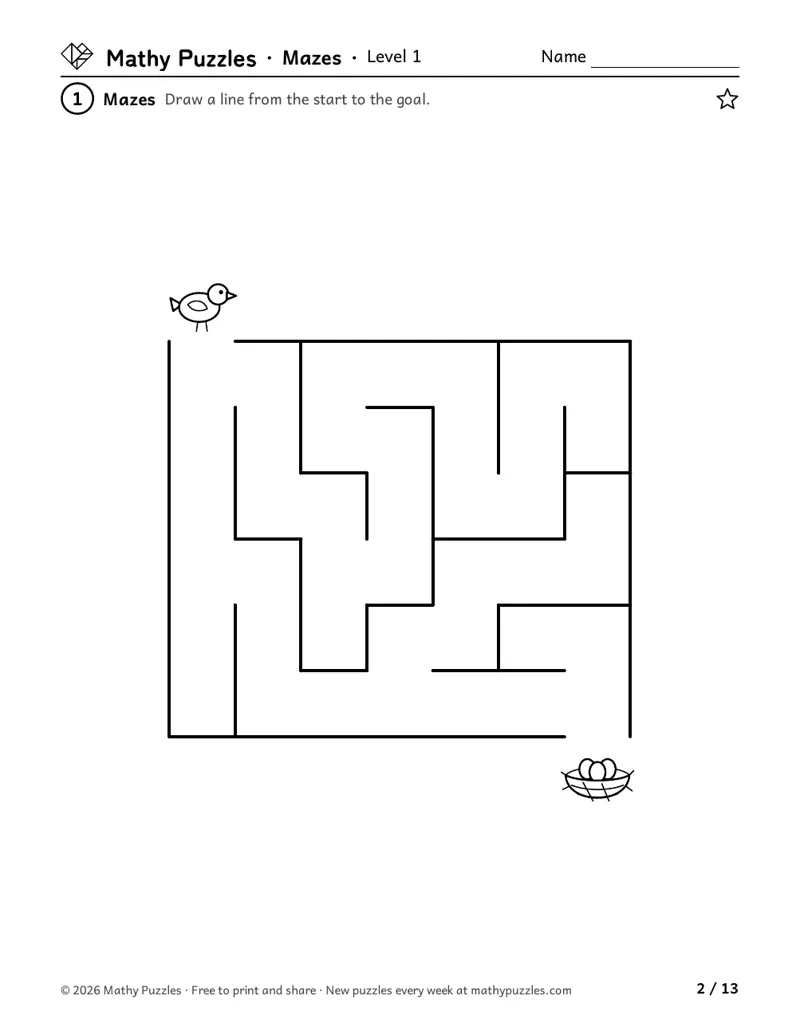 Level 1: a page from the free set
Before starting
- Level 1: hold a pencil and draw a line between two walls
- Level 1: count to 5 for the collect-on-the-way mazes
Free puzzles to print
Each set: a Learn sheet with a worked example, 10 puzzles from easiest to hardest, and the answers.
Level 1
Ages 4–6 · Pre-K–K
The easiest mazes are small grids, 6 or 7 squares across, with wide paths and short dead ends.
Then grids of 8 to 10 squares. Some have three starts where only one reaches the goal, or ask "How many carrots can you take home?" (going back along your line is allowed). Others have a puddle, mud, a cactus or a sleeping cat to go around, or sit inside a shape or a block letter.
Then grids of 11 to 12 squares: three starts again, and "How many carrots are on the way home?" with no going back. These also bring more things to go around, shape mazes, and circle mazes from the outside in.
The hardest mazes are challenge grids of 13 to 14 squares with narrow paths.
On the sheet: “Find the way from the start to the goal.”
Print Level 1 (Letter)Other paper size: A4
How it works
A picture maze with a small story: help the bunny reach its carrot, or the bee reach its flower. The child draws a line from the start to the goal without crossing a wall. The format changes from sheet to sheet. There are square grids, three starts where only one gets through, mazes where you collect carrots on the way, and mazes with puddles to avoid. There are also mazes inside a shape, such as a heart or a block letter, and circle mazes from the outside in. There are no numbers on the path; that is Number Mazes.
How to play
- Read the story and find the start and the goal.
- Trace a route with your finger first. Look ahead at each turn.
- At a dead end, go back to the last place with a choice and try the other way.
- Draw the line once you know the way. Read the question again if there are carrots to count or puddles to avoid.
When it gets hard
Drawing straight through a wall.
Hint: Walls are solid. Trace with a finger first and stop when you touch a wall.
Starting over from the beginning after every dead end.
Hint: Go back only to the last place where the path split.
Counting carrots in a side lane on a "no going back" maze.
Hint: Count only the ones your line really passes.
Going through a puddle because it is the short way.
Hint: Read the rule again. Which way goes around every puddle?
Tip for grown-ups: At each turn, a quick "This way or that way?" helps. Tracing with a finger and saying the choice out loud slows the pencil down.
Frequently asked questions
- How is this different from Number Mazes?
- Here the walls make the path, and the child finds a route. In Number Mazes there are no walls; the child steps only on squares that follow a number rule. Number Paths is different again: the child writes numbers in order. Many children enjoy all three.
- Why do some mazes have more than one way through?
- The mazes with something to go around (a puddle, mud, a cactus) have loops on purpose, so more than one route reaches the goal. The rule decides which routes count: only a way that misses every hazard. The answers show one way that follows the rule.
Questions about printing, levels, answers or membership: see all questions.
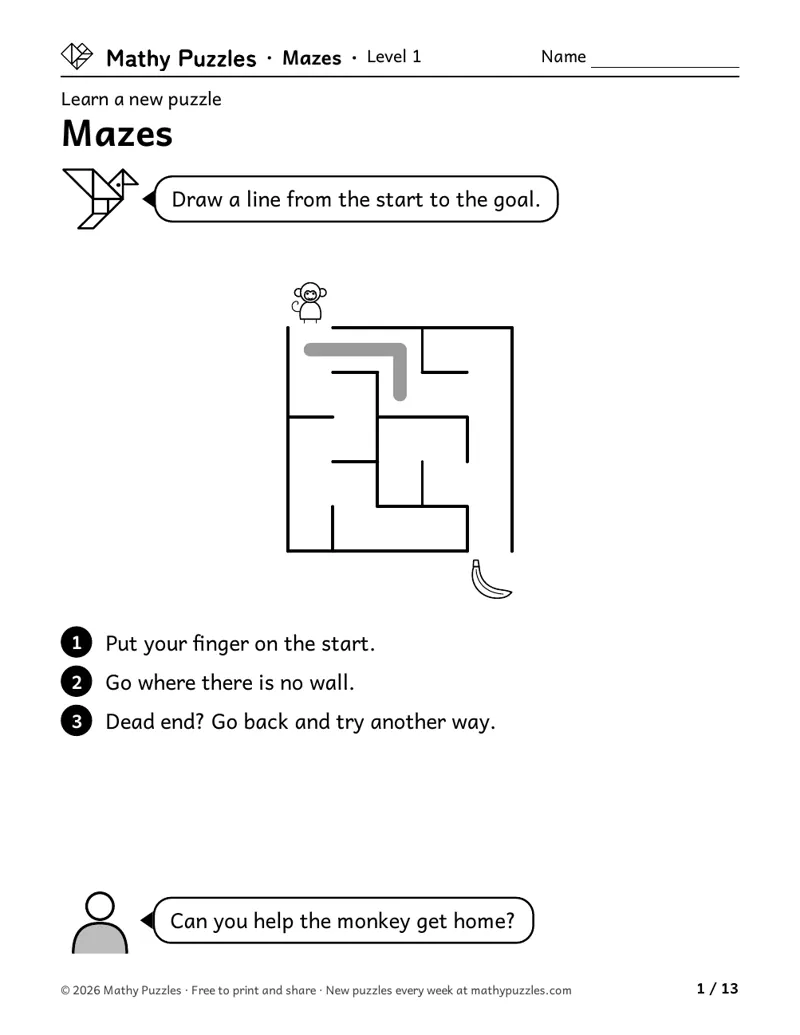
Worked example
From the Level 1 Learn sheet
- Draw a line from the start to the goal.
- Put your finger on the start.
- Go where there is no wall.
- Dead end? Go back and try another way.
A question to ask: “Can you help it get home?”
Free every Sunday A mixed bag of 20 new puzzles, all four levels. Get them by email
The thinking it works on
Planning ahead
Looks down a path before choosing it.
Kaller and colleagues (2008) found that 4-year-olds planned less accurately on puzzles that needed looking ahead, while 5-year-olds handled those as well as step-by-step ones. Source
Going back and trying again
Returns to the last choice after a dead end.
Following a rule on the way
Keeps a rule in mind the whole way.
Zelazo and colleagues (2003) found that most 3- and 4-year-olds kept sorting cards by an old rule after being told a new one. Yet they could handle several rules at once when the rules did not pull against each other. Source
Seeing routes in space
Follows twisting paths with the eyes.
Kovács and colleagues (1999) found that children's skill at picking out a path of lined-up marks among scattered ones kept growing between ages 5 and 14. Source
Counting on the route
Counts only the things the route passes.
Pencil control
Draws a line between two walls without touching them.
Rueckriegel and colleagues (2008) tested 187 people aged 6 to 18 drawing and writing on a tablet. Their pen movements grew faster, smoother and steadier with age. Source
Where is this thinking used?
- Maps and directions: A route is planned before setting off, and a wrong turn means going back.
- Finding your way in a big building: Halls with dead ends call for the same "go back to the last choice" habit.
- Puzzle and video games: Levels are mazes with goals, items to collect and things to avoid.
- Errand planning: Picking up things on the way home is a route with stops.
For teachers
Curriculum areas
- Common Core
- Counting and cardinality (Kindergarten): the mazes where the child collects things on the way count small groups
- NCERT
- No direct curricular match.
- National Curriculum (England)
- No direct curricular match.
- Cambridge Primary Mathematics
- No direct curricular match.
Math practices: see the box below.
Math practices this puzzle uses
- Uses: MP1 Make sense of problems and persevere in solving them
- Not used: MP2 Reason abstractly and quantitatively
- Not used: MP3 Construct viable arguments and critique the reasoning of others
- Not used: MP4 Model with mathematics
- Not used: MP5 Use appropriate tools strategically
- Not used: MP6 Attend to precision
- Not used: MP7 Look for and make use of structure
- Not used: MP8 Look for and express regularity in repeated reasoning
From the Common Core Standards for Mathematical Practice.
More Mazes puzzles for members
Members get at least 5 more worksheets at each difficulty for every puzzle, 80 new puzzles every Sunday, and the whole archive. $39 a year or $25 for 6 months.
See membershipNot ready yet?
One email, all four levels: 20 puzzles, 5 for each level.
For grown-ups (18+). One email every Sunday with the puzzles and the odd note about membership; unsubscribe any time. We never ask about your child. How we use your email