
Fraction Puzzles
Half a sandwich is easy to picture. Harder is seeing a half as a number with its own spot on a line, between 0 and 1. These puzzles work with fractions that way, and fractions with different bottom numbers can be compared and added once they share one.
Free sets by level, ages 8–12:
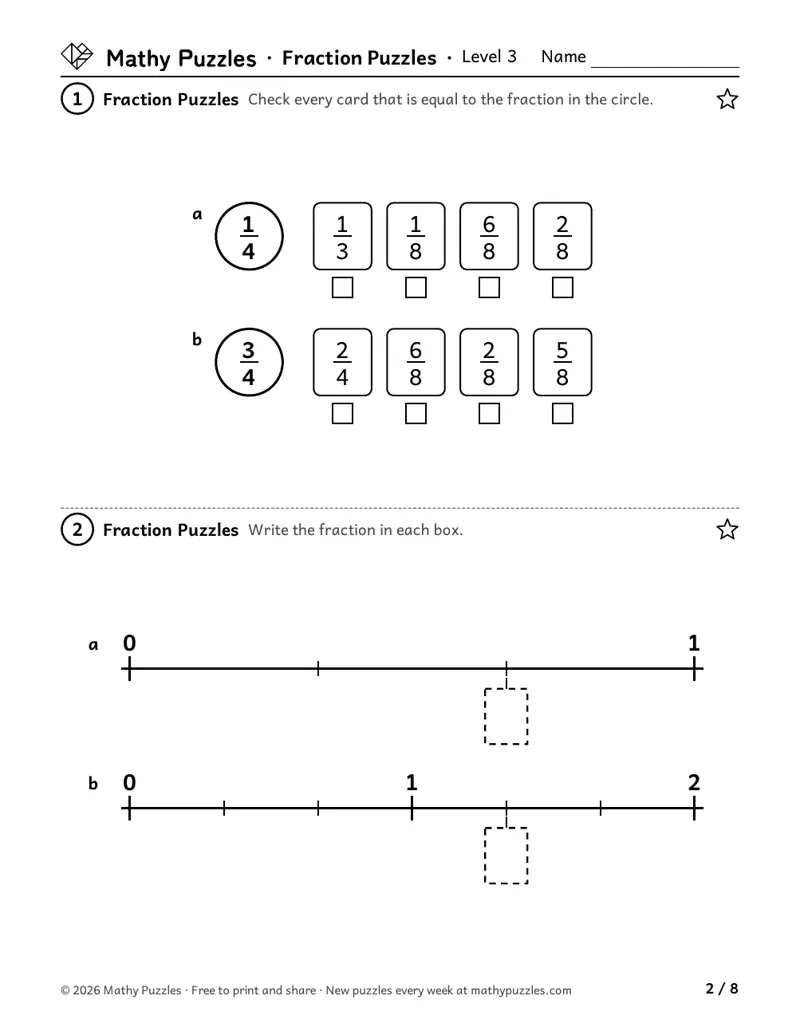 Level 3: a page from the free set
Before starting
- Level 3: know what 1/2, 1/3 and 1/4 mean; add and subtract whole numbers to about 40
- Level 4: multiplication facts to 10 × 10, and equal fractions such as 1/2 = 2/4
What you need
A ruler to keep the number-line jumps straight, and a pencil.
Free puzzles to print
Each set: a Learn sheet with a worked example, 10 puzzles from easiest to hardest, and the answers.
Level 3
Ages 8–10 · Grades 3–4
First, number lines from 0 to 1 or 0 to 2 in halves, thirds, fourths, sixths and eighths, and matching equal fractions. Then ordering four fractions, and matching with fifths, tenths and twelfths. Then fraction pyramids with one bottom number (eighths, tenths or twelfths), 3 or 4 rows. The hardest pyramids mix halves and fourths, fourths and eighths, or thirds and sixths.
On the sheet: “Fill in the fractions.”
Print Level 3 (Letter)Other paper size: A4Level 4
Ages 10–12 · Grades 5–6
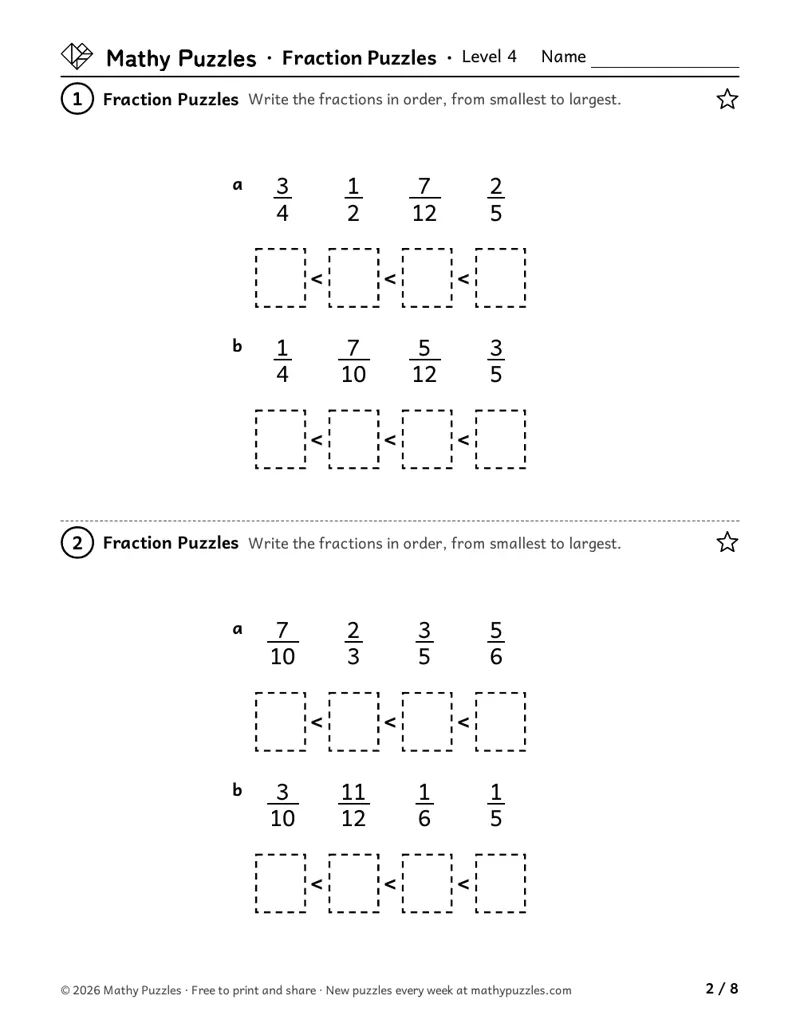
First, ordering four fractions with different bottom numbers. Then pyramids that mix bottom numbers where one is a multiple of the other. Then ones that need a new bottom number (halves and thirds, thirds and fourths, or halves and fifths). The hardest add mixed numbers like 1 1/2.
On the sheet: “Fill in the fractions.”
Print Level 4 (Letter)Other paper size: A4
How it works
These puzzles treat fractions as numbers, with no shaded shapes. At Level 3 the child writes fractions on a number line, picks the cards equal to a fraction and puts four fractions in order. The child also fills fraction pyramids, where each brick is the sum of the two below. At Level 4 the fractions in one puzzle have different bottom numbers (denominators). So the child first finds one bottom number that works for all of them.
How to play
- On a number line, count the equal jumps from 0 to 1. That is the bottom number. Count jumps from 0 to the box for the top number.
- To order fractions, first compare ones with the same top or bottom number, or check each one against 1/2.
- In a pyramid, add the two bricks below to get the brick above. If a lower brick is missing, take away.
- When the bottom numbers differ, change them to one shared bottom number before you add.
When it gets hard
Counting the tick marks instead of the jumps.
Hint: Count the spaces between marks. A line from 0 to 1 with 9 marks has 8 jumps.
Thinking 1/8 is bigger than 1/4 because 8 is bigger than 4.
Hint: The bottom number says how many equal parts the whole is cut into. More parts means smaller parts.
Adding the bottom numbers: 1/2 + 1/3 = 2/5.
Hint: Give both the same bottom number first: 3/6 + 2/6 = 5/6. Only the top numbers add.
Tip for grown-ups: Have your child read fractions aloud as "3 jumps of one-eighth" rather than "3 over 8". It keeps the meaning in view. A ruler keeps the number-line jumps straight and equal.
Frequently asked questions
- Why are there no pizzas or shaded shapes?
- These puzzles treat fractions as numbers on a line and in sums. That is the step many children find hard after shading shapes, so it gets its own practice here.
- Which lessons does Level 3 line up with?
- Grade 3 fraction work: fractions on a number line, equal fractions and comparing. The pyramids add fractions with the same bottom number, which is Grade 4 work. Level 4 adds fractions with different bottom numbers, a Grade 5 topic.
- My child writes 1/3 + 1/4 = 2/7. How can I help?
- That is the most common slip. Ask what the bottom number means. Then look at the Level 4 Learn sheet together: 1/2 and 1/3 become 3/6 and 2/6 before they are added.
Questions about printing, levels, answers or membership: see all questions.
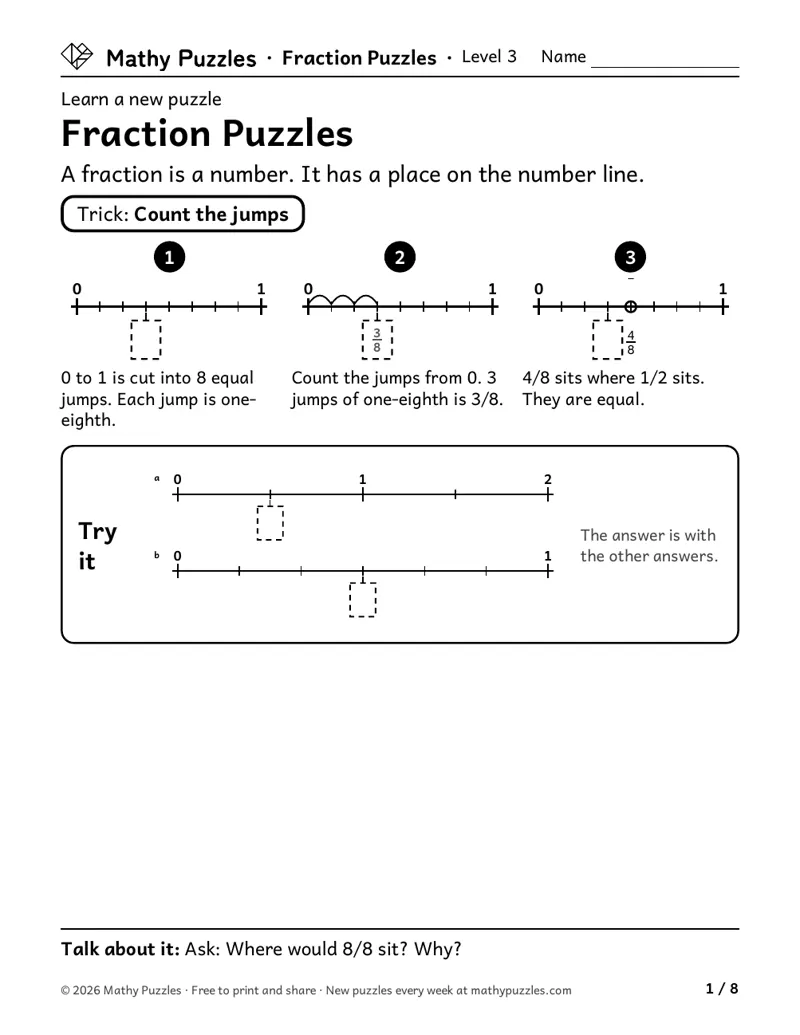
Worked example
From the Level 3 Learn sheet
- 0 to 1 is cut into 8 equal jumps. Each jump is one-eighth.
- Count the jumps from 0. 3 jumps of one-eighth is 3/8.
- 4/8 sits where 1/2 sits. They are equal.
A question to ask: “Where would 8/8 sit? Why?”
Free every Sunday A mixed bag of 20 new puzzles, all four levels. Get them by email
The thinking it works on
Fractions as numbers
Sees a fraction as one number with a place on the line.
Smith, Solomon and Carey (2005) interviewed third to sixth graders. Those who saw numbers as endlessly divisible, never reaching zero, also judged the sizes of fractions and decimals better. Source
Spotting equal fractions
Recognizes different-looking fractions that name the same number.
Ni (2001) tested 413 Chinese fifth and sixth graders and found that equivalent fractions were hard for fifth graders, with sixth graders better only on part-of-a-whole pictures. Source
Comparing and ordering
Uses same top, same bottom or 1/2 as a guide to put fractions in order.
Ten- and 12-year-olds who could correctly compare fractions with the same top or bottom number were slower when the tops matched. The bigger bottom number still pulled at them, even when they got the answer right. Source
Adding and taking away in a pyramid
Adds up a pyramid and takes away to find a missing lower brick.
Braithwaite, Tian and Siegler (2017) asked fourth to eighth graders to estimate the sum of two fractions. About half their estimates were smaller than one of the fractions being added. Source
Finding a common bottom number
Finds one bottom number that works for two different fractions.
Where is this thinking used?
- Cooking: Adding a third of a cup and a quarter cup, or doubling half a recipe.
- Measuring: Reading a ruler marked in eighths of an inch.
- Time: Adding a quarter hour and half an hour.
- Sharing: Splitting a pizza between friends who want different amounts.
For teachers
Curriculum areas
- Common Core
- Number and operations: fractions: fractions on the number line, equal fractions and comparing (Grades 3–4); adding fractions with like denominators (Grade 4) and unlike denominators (Grade 5)
- NCERT
- Maths Mela: Sharing and Measuring (Class 4), Fractions (Class 5); Ganita Prakash (Class 6): Fractions, including adding fractions with different bottom numbers
- National Curriculum (England)
- Number – fractions: fractions as numbers, equivalent fractions, comparing and adding (Years 3–5); different denominators and mixed numbers (Year 6)
- Cambridge Primary Mathematics
- Fractions: equal fractions, ordering, adding with the same and different denominators, mixed numbers (Stages 4–6)
Math practices: see the box below.
Math practices this puzzle uses
- Not used: MP1 Make sense of problems and persevere in solving them
- Not used: MP2 Reason abstractly and quantitatively
- Not used: MP3 Construct viable arguments and critique the reasoning of others
- Not used: MP4 Model with mathematics
- Not used: MP5 Use appropriate tools strategically
- Uses: MP6 Attend to precision
- Uses: MP7 Look for and make use of structure
- Not used: MP8 Look for and express regularity in repeated reasoning
From the Common Core Standards for Mathematical Practice.
More Fraction Puzzles for members
Members get at least 5 more worksheets at each difficulty for every puzzle, 80 new puzzles every Sunday, and the whole archive. $39 a year or $25 for 6 months.
See membershipNot ready yet?
One email, all four levels: 20 puzzles, 5 for each level.
For grown-ups (18+). One email every Sunday with the puzzles and the odd note about membership; unsubscribe any time. We never ask about your child. How we use your email