
Cube Nets & Dice
Cut open a small cardboard box, lay it flat, and you get an odd cross-like shape. Every box has a flat shape like that, called a net. These puzzles ask the child to fold it back up in their head, with no scissors and no tape.
Free sets by level, ages 8–10:
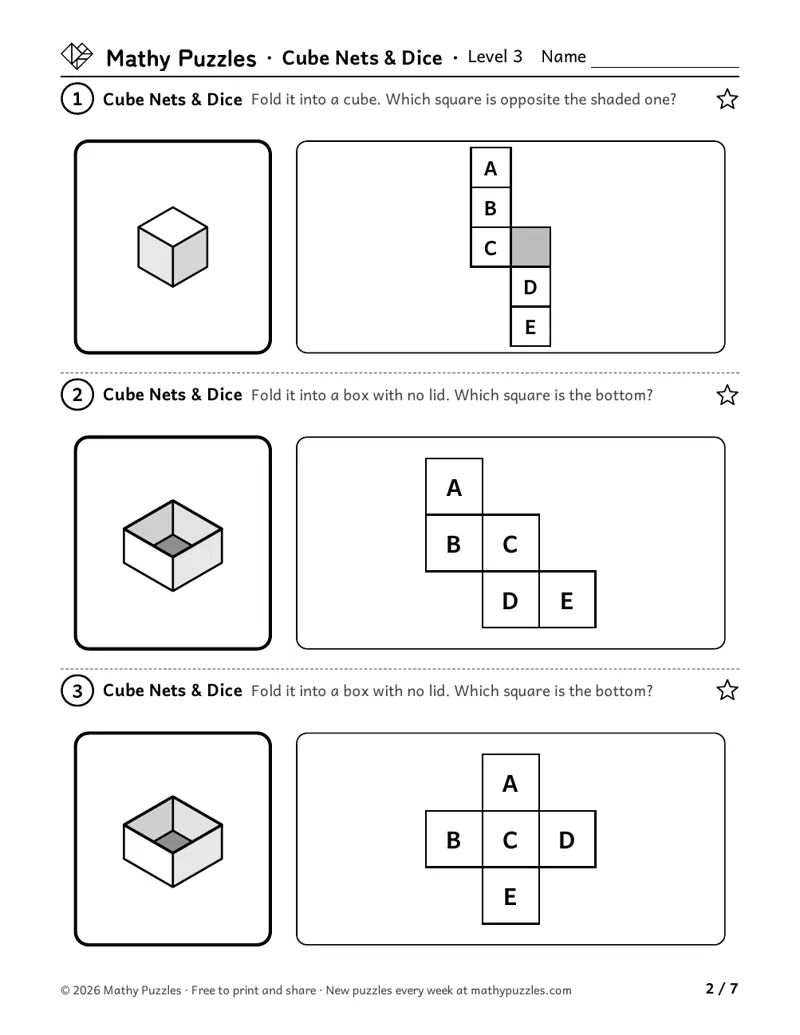 Level 3: a page from the free set
Before starting
- Know that a cube has 6 square faces
- Have folded a paper box or seen one unfolded
What you need
Paper and scissors to cut out a net and fold it, and a pencil.
Free puzzles to print
Each set: a Learn sheet with a worked example, 10 puzzles from easiest to hardest, and the answers.
Level 3
Ages 8–10 · Grades 3–4
The easiest puzzles: an open box from 5 squares (which square is the bottom?), and a cube net (which square ends up opposite the shaded one?).
The middle puzzles: which of 4 shapes of 6 squares folds into a cube?
The harder puzzles: a net with 6 symbols; which of 4 dice is it folded up?
On the sheet: “Fold it up in your head.”
Print Level 3 (Letter)Other paper size: A4
How it works
A net is a flat shape that folds up into a box. Each puzzle shows one or more nets and asks a folding question. Which square becomes the bottom of an open box? Which of these shapes folds into a cube? Which die do you get when a net with symbols on it is folded up?
How to play
- Pick one square to be the bottom. Imagine the squares around it folding up like walls.
- Follow the squares one at a time. Each one folds over its shared edge.
- For a cube: two squares can't land on the same side. If they would, the net doesn't work.
- For dice: squares that are opposite on the cube can never be seen side by side.
When it gets hard
Thinking any 6 squares joined together make a cube.
Hint: Fold it one square at a time. Do two squares try to cover the same face?
Picking a die that shows two opposite faces next to each other.
Hint: Look along a straight line of three squares on the net. Where do the two ends go?
Picking a die with the right three faces in mirror order.
Hint: Go around the three faces of the corner in order. Does the net go around the same way?
Tip for grown-ups: Draw the net on paper, cut it out and fold it to settle any argument; an empty cereal box opened flat also makes a good example.
Frequently asked questions
- How do I bring this to a grade 3 class?
- Have students fold one paper net first, then do the sheet. Early finishers can draw a net of their own and test whether it folds.
- What if my child can't picture the folding?
- Cut out the net, fold it, and talk about which square went where. After two or three real folds the picture usually comes.
- How can my child check a dice answer?
- First cross out any die that shows two opposite faces side by side. Then go around the corner of the die and check that the three faces come in the same order as on the net. The answers show which die it is.
Questions about printing, levels, answers or membership: see all questions.
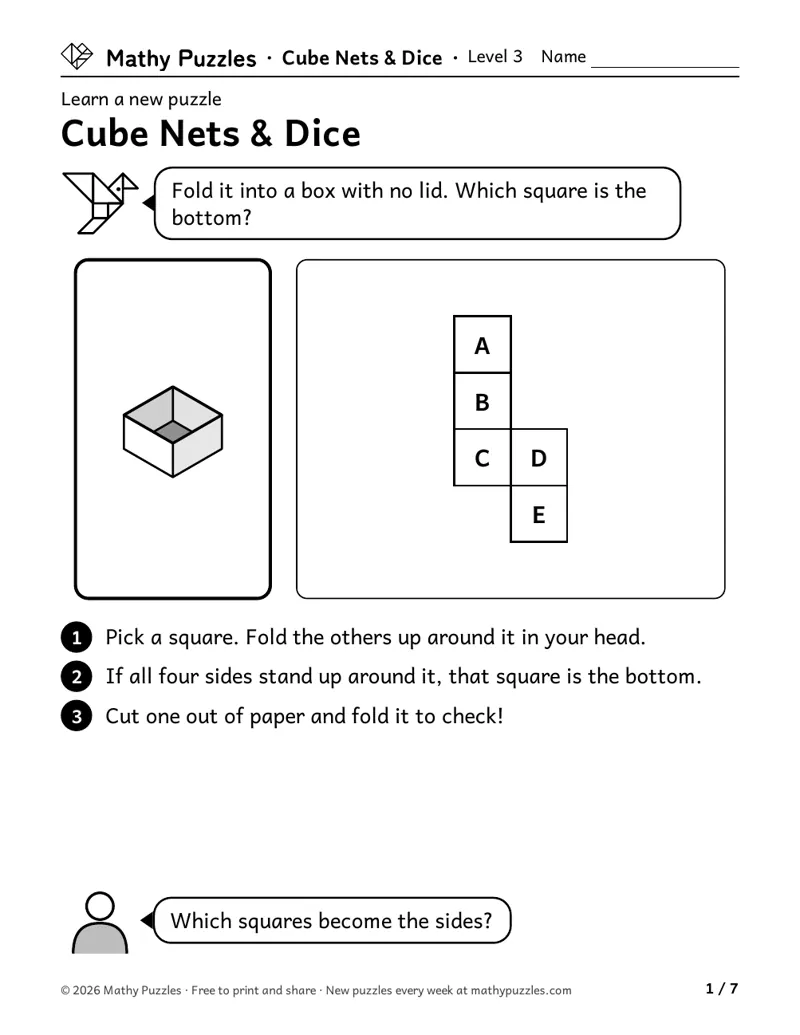
Worked example
From the Level 3 Learn sheet
- Pick a square. Fold the others up around it in your head.
- If all four sides stand up around it, that square is the bottom.
- Cut one out of paper and fold it to check!
A question to ask: “Which squares become the sides?”
Free every Sunday A mixed bag of 20 new puzzles, all four levels. Get them by email
The thinking it works on
Folding a flat net in the mind
Picks a square as the bottom and folds the others up over their edges in the head.
Harris, Newcombe and Hirsh-Pasek (2013) found that young children start to picture a simple paper fold at around 5 and a half, with large differences between children. Source
Tracking where each face ends up
Follows each square to its place and spots two landing on the same face.
Mix and colleagues (2016) found that the spatial skills most closely tied to math shift with age. In kindergarten it is turning shapes; by grade 6 it is holding and moving pictures in mind (visuospatial working memory). Source
Finding opposite faces
Finds the rule for which squares end up opposite each other.
Telling a turn from a mirror image
Checks that the faces around a corner go the same way on the net and the die.
In Kail's (1991) tests, the further a letter was turned, the longer 9- and 10-year-olds took to say whether it was normal or mirror-reversed. Source
Testing an idea and ruling it out
Tries a square as the bottom, and tries another if the walls would overlap.
Diamond (2013) describes switching approach when the first idea fails (cognitive flexibility) as a core thinking skill that develops through childhood. Source
Folding for real
Cuts out and folds a net to settle an argument.
Where is this thinking used?
- Packaging: A flat cardboard sheet is printed, then folded into a box.
- Sewing: A flat pattern becomes a 3D garment.
- Sheet-metal work and architecture: A part, or a building's sides, is drawn unfolded and then bent or built.
- Dice and game pieces: The faces are laid out flat so they land in the right places when folded.
For teachers
Curriculum areas
- Common Core
- Geometry: 3D shapes and their faces (K–2); Geometry: nets and surface area (Grade 6, ahead of Level 3)
- NCERT
- Nets, dice and solids in Shapes Around Us (Class 4); cube views on a net (Class 5)
- National Curriculum (England)
- Geometry – properties of shapes: 3-D shapes from 2-D drawings (Year 5); nets of 3-D shapes (Year 6)
- Cambridge Primary Mathematics
- Geometry and measure: matching nets to 3D shapes; nets of a cube (Stages 4–5)
Math practices: see the box below.
Math practices this puzzle uses
- Uses: MP1 Make sense of problems and persevere in solving them
- Not used: MP2 Reason abstractly and quantitatively
- Not used: MP3 Construct viable arguments and critique the reasoning of others
- Not used: MP4 Model with mathematics
- Not used: MP5 Use appropriate tools strategically
- Not used: MP6 Attend to precision
- Uses: MP7 Look for and make use of structure
- Not used: MP8 Look for and express regularity in repeated reasoning
From the Common Core Standards for Mathematical Practice.
More Cube Nets & Dice puzzles for members
Members get at least 5 more worksheets at each difficulty for every puzzle, 80 new puzzles every Sunday, and the whole archive. $39 a year or $25 for 6 months.
See membershipNot ready yet?
One email, all four levels: 20 puzzles, 5 for each level.
For grown-ups (18+). One email every Sunday with the puzzles and the odd note about membership; unsubscribe any time. We never ask about your child. How we use your email