
Area Puzzles
Tell a child a rectangle has an area of 24 and one side of 6, and they can find the other side without a ruler. Area Puzzles chain that one small step from rectangle to rectangle, until the number marked "?" has nowhere left to hide.
Free sets by level, ages 10–12:
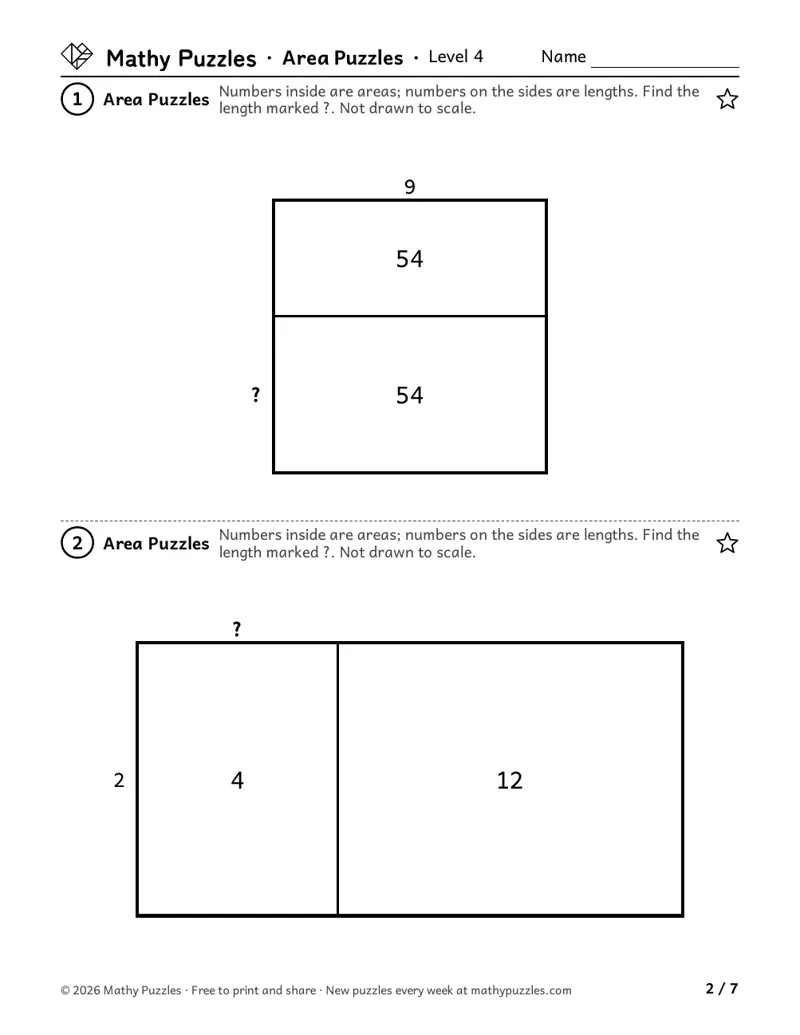 Level 4: a page from the free set
Before starting
- Multiplication facts to 10 × 10
- Know that area of a rectangle is length × width
- Divide using multiplication facts (24 ÷ 6)
Free puzzles to print
Each set: a Learn sheet with a worked example, 10 puzzles from easiest to hardest, and the answers.
Level 4
Ages 10–12 · Grades 5–6
The easiest puzzles: two rectangles, side by side or one above the other; one or two steps.
The middle puzzles: a 2 × 2 grid of rectangles; a chain of 2 to 3 steps.
The harder puzzles: a 2 × 3 or 3 × 3 grid; a chain of 4 or more steps.
The hardest puzzles: a 4 × 3 or 3 × 4 grid with one column or row left empty. The length of a whole side is written outside, so one step takes away (the whole side minus the known parts); 6 or more steps in all.
On the sheet: “Find the missing number. Not drawn to scale.”
Print Level 4 (Letter)Other paper size: A4
How it works
Picture a garden split into smaller beds. Some beds have their area written in, some have a side length, and one has a question mark. The child works from bed to bed: the area divided by a known side gives the missing side, and that side is shared with the next bed. The drawing is not to scale on purpose, so a ruler is no help. Only the numbers count.
How to play
- Find a small rectangle where you know its area and one side.
- Divide to find its other side.
- That side is shared with the next rectangle. Use it to find something new there.
- Keep going, one rectangle at a time, until you reach the "?".
When it gets hard
Measuring the drawing with a ruler.
Hint: It is not drawn to scale. Only the numbers count.
Adding sides instead of multiplying.
Hint: Area is length times width. Which do you know, and which do you need?
Using a side that belongs to a different row or column.
Hint: Rectangles in the same column share a width. Trace the column with your finger.
Tip for grown-ups: Writing each step next to its rectangle pays off: when a chain goes wrong, the written steps show where.
Frequently asked questions
- Can my child use a ruler?
- No; the drawings are not to scale on purpose. The numbers alone give the answer, and that is the point of the puzzle.
- Does every child solve it in the same order?
- Often several orders of steps reach the same number. The answers give the number; the route is your child's to explain.
Questions about printing, levels, answers or membership: see all questions.
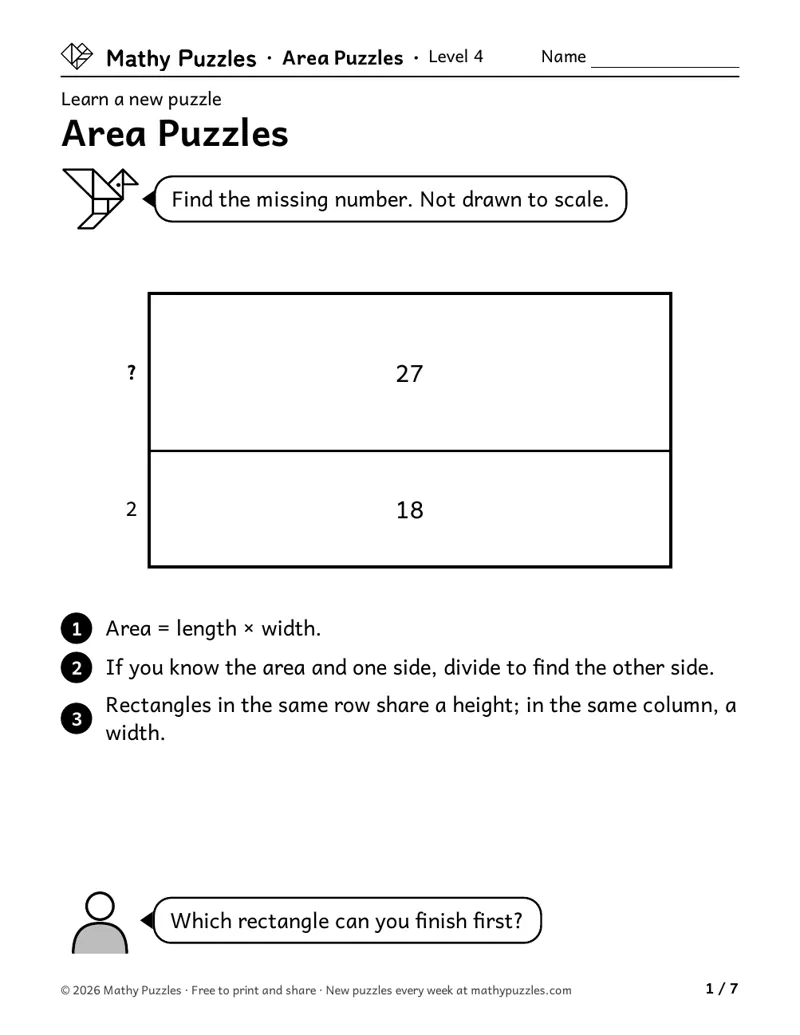
Worked example
From the Level 4 Learn sheet
- Area = length × width.
- If you know the area and one side, divide to find the other side.
- Rectangles in the same row share a height; in the same column, a width.
A question to ask: “Which rectangle can you finish first?”
Free every Sunday A mixed bag of 20 new puzzles, all four levels. Get them by email
The thinking it works on
Multiplicative thinking forward and backward
Multiplies to get an area, or divides to get a missing side.
Dubé and Robinson (2018) found that even in grades 6 to 8, many children do not yet use the idea that division undoes multiplication. Children differed widely. Source
Planning a chain of steps
Works out which rectangle to solve first so its answer unlocks the next.
Albert and Steinberg (2011) found that the ability to plan several moves ahead is still growing between age 10 and the early twenties. Working memory and self-control explain part of it. Source
Seeing shared sides
Uses one rectangle's side as the next rectangle's side.
Trusting the numbers, not the picture
Reasons from the numbers, not from how big the drawing looks.
Researchers describe many of children's reasoning errors as misleading intuitions that need to be held back (inhibited), and the capacity to do so keeps developing through childhood. Source
Holding several numbers in mind
Keeps track of what is known, just found and still needed.
Gathercole and colleagues (2004) found that the capacity to hold and work with several things in mind grows roughly in a straight line from age 4 to 15. Source
Linking area to length
Sees that area and side lengths fix each other.
Outhred and Mitchelmore (2000) studied 115 children in grades 1 to 4. The most advanced worked out how many squares cover a rectangle from the lengths of its sides. Source
Where is this thinking used?
- Home jobs: Working out paint, carpet or fencing from a few measurements.
- Floor plans: One known room size fixes the sizes next to it.
- Diagrams not to scale: A wiring plan or a subway map shows connections, not sizes.
For teachers
Curriculum areas
- Common Core
- Measurement: area of rectangles and the area formula (Grades 3–4); solving simple equations with a missing factor (Grade 6)
- NCERT
- Perimeter and area (Classes 5–6)
- National Curriculum (England)
- Measurement: area of rectangles (Year 5) and when an area formula can be used (Year 6); Geometry: missing lengths from rectangle properties (Year 5)
- Cambridge Primary Mathematics
- Geometry and measure: area of rectangles, and of shapes split into rectangles (Stages 4–5)
Math practices: see the box below.
Math practices this puzzle uses
- Uses: MP1 Make sense of problems and persevere in solving them
- Uses: MP2 Reason abstractly and quantitatively
- Not used: MP3 Construct viable arguments and critique the reasoning of others
- Not used: MP4 Model with mathematics
- Not used: MP5 Use appropriate tools strategically
- Not used: MP6 Attend to precision
- Not used: MP7 Look for and make use of structure
- Not used: MP8 Look for and express regularity in repeated reasoning
From the Common Core Standards for Mathematical Practice.
More Area Puzzles for members
Members get at least 5 more worksheets at each difficulty for every puzzle, 80 new puzzles every Sunday, and the whole archive. $39 a year or $25 for 6 months.
See membershipNot ready yet?
One email, all four levels: 20 puzzles, 5 for each level.
For grown-ups (18+). One email every Sunday with the puzzles and the odd note about membership; unsubscribe any time. We never ask about your child. How we use your email